WEB4-002 · WEB4
The Return of the Principal-Agent Problem
The farther instructions travel, the easier they are to misunderstand or redirect.
01
Big idea
The farther instructions travel, the easier they are to misunderstand or redirect.
Picture
See the structure
The simple version
Explain it like I’m ten
Mom asks her son to buy milk. He asks his friend, who asks a little brother. The little brother comes home with ice cream. Everyone tried to help, but the farther the request traveled, the easier it became to change.
Tell it at dinner
A story worth remembering
Mom asks her son to buy milk. He asks his friend, who asks a little brother. The little brother comes home with ice cream. Everyone tried to help, but the farther the request traveled, the easier it became to change.
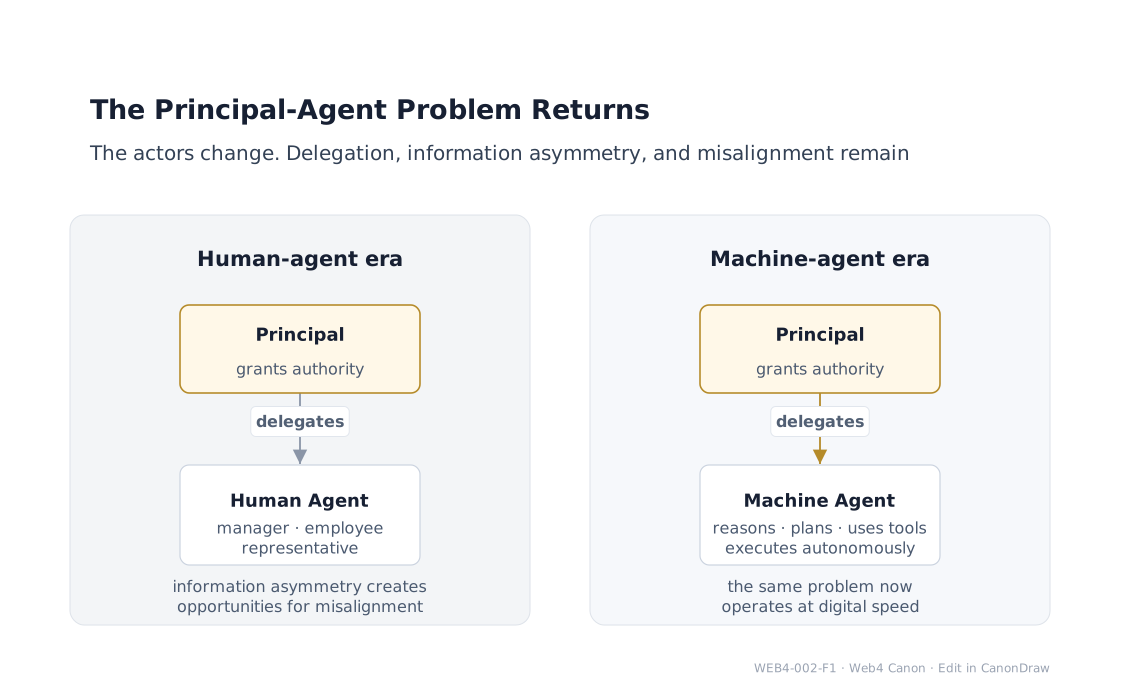
Now make the same problem larger: replace the children and ordinary objects with people, organizations, AI agents, robots, records, and resources moving at machine speed. Autonomous agents renew the principal-agent problem at machine scale because delegated actors can interpret, optimize, and redelegate imperfectly while the original principal retains risk. Boards and governments must treat agency loss, misaligned incentives, and redelegation as operating risks rather than isolated model errors.
Pause at the moment the small system could go wrong. That is the design question the paper keeps in view: not whether people or helpers are clever, but whether the surrounding structure preserves the intended meaning when action scales.
That is why the small story holds: the farther instructions travel, the easier they are to misunderstand or redirect.
Explain it to a CEO
Why leaders should care
Boards and governments must treat agency loss, misaligned incentives, and redelegation as operating risks rather than isolated model errors. Autonomous agents renew the principal-agent problem at machine scale because delegated actors can interpret, optimize, and redelegate imperfectly while the original principal retains risk.
Explain it to an engineer
What the model means
Represent principal, agent, objective, information asymmetry, incentive, monitoring, and delegation depth explicitly. Controls should preserve scope and accountability across each handoff without assuming perfect alignment.
Talk hook
The oldest problem in management is about to become the biggest problem in AI.
Ask the room
Where in your organization can a delegated objective change without the original principal noticing?
Go deeper
The Canon is the source of truth.
WEB4-002 formalizes this structure: Autonomous agents renew the principal-agent problem at machine scale because delegated actors can interpret, optimize, and redelegate imperfectly while the original principal retains risk. The ordinary-life story is an intuition aid, not a replacement definition; the canonical paper remains authoritative for scope, terminology, limitations, and argument.
Read WEB4-002 — the authoritative paper →