WEB4-003 · WEB4
The Agentic Firm
An agentic firm scales through governed helpers, not unbounded automation.
01
Big idea
An agentic firm scales through governed helpers, not unbounded automation.
Picture
See the structure
The simple version
Explain it like I’m ten
A baker cannot mix every bowl, watch every oven, greet every customer, and deliver every loaf. She gives different helpers different jobs. The bakery works only when each helper knows the recipe, the limits of the job, and who checks the bread.
Tell it at dinner
A story worth remembering
A baker cannot mix every bowl, watch every oven, greet every customer, and deliver every loaf. She gives different helpers different jobs. The bakery works only when each helper knows the recipe, the limits of the job, and who checks the bread.
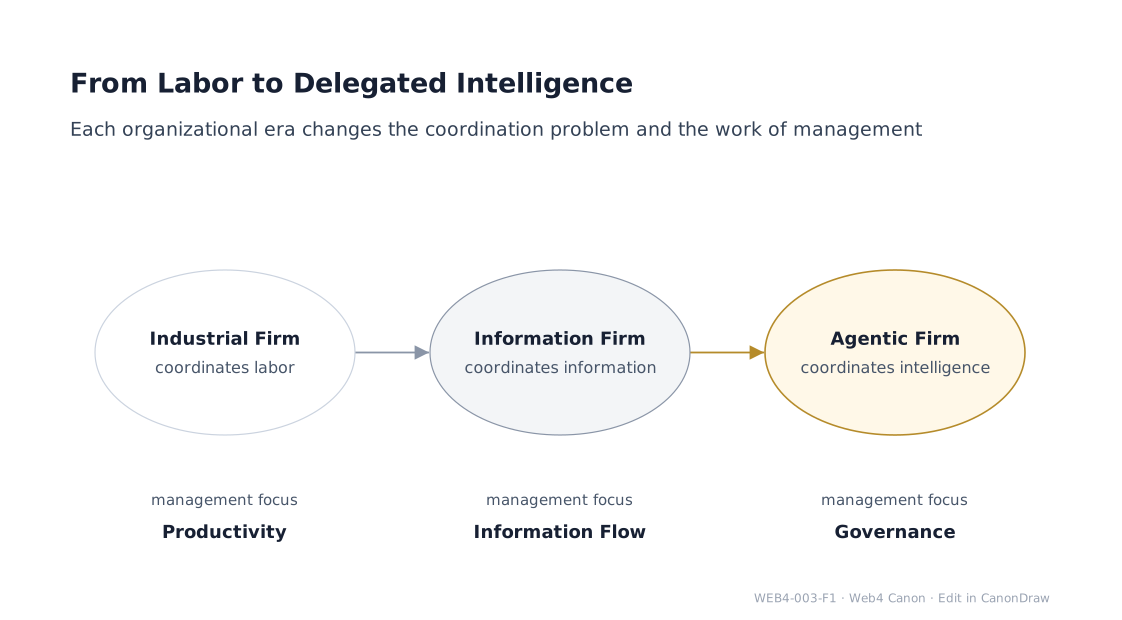
Now make the same problem larger: replace the children and ordinary objects with people, organizations, AI agents, robots, records, and resources moving at machine speed. The agentic firm reorganizes work around humans and intelligent agents acting through explicit authority, specialization, coordination, and accountability. Firms can expand productive capacity while preserving a governable operating model for who decides, who executes, and who remains responsible.
Pause at the moment the small system could go wrong. That is the design question the paper keeps in view: not whether people or helpers are clever, but whether the surrounding structure preserves the intended meaning when action scales.
That is why the small story holds: an agentic firm scales through governed helpers, not unbounded automation.
Explain it to a CEO
Why leaders should care
Firms can expand productive capacity while preserving a governable operating model for who decides, who executes, and who remains responsible. The agentic firm reorganizes work around humans and intelligent agents acting through explicit authority, specialization, coordination, and accountability.
Explain it to an engineer
What the model means
Treat agents as organizational actors with identity, roles, delegated scopes, workflows, constraints, telemetry, and escalation paths. The paper is an institutional model, not a specific software topology.
Talk hook
What changes when your next thousand coworkers are software agents?
Ask the room
Which decisions should agents execute, and which responsibilities must remain visibly human?
Go deeper
The Canon is the source of truth.
WEB4-003 formalizes this structure: The agentic firm reorganizes work around humans and intelligent agents acting through explicit authority, specialization, coordination, and accountability. The ordinary-life story is an intuition aid, not a replacement definition; the canonical paper remains authoritative for scope, terminology, limitations, and argument.
Read WEB4-003 — the authoritative paper →