WEB4-001 · WEB4
The Authority Graph
The Authority Graph is a permission-slip system for digital helpers.
01
Big idea
The Authority Graph is a permission-slip system for digital helpers.
Picture
See the structure
The simple version
Explain it like I’m ten
A school is taking a field trip. Every child has a permission slip, every teacher knows their group, and every bus has a list. If someone asks, “Who said Maya could ride this bus?” the school can follow the answer all the way back.
Tell it at dinner
A story worth remembering
A school is taking a field trip. Every child has a permission slip, every teacher knows their group, and every bus has a list. If someone asks, “Who said Maya could ride this bus?” the school can follow the answer all the way back.
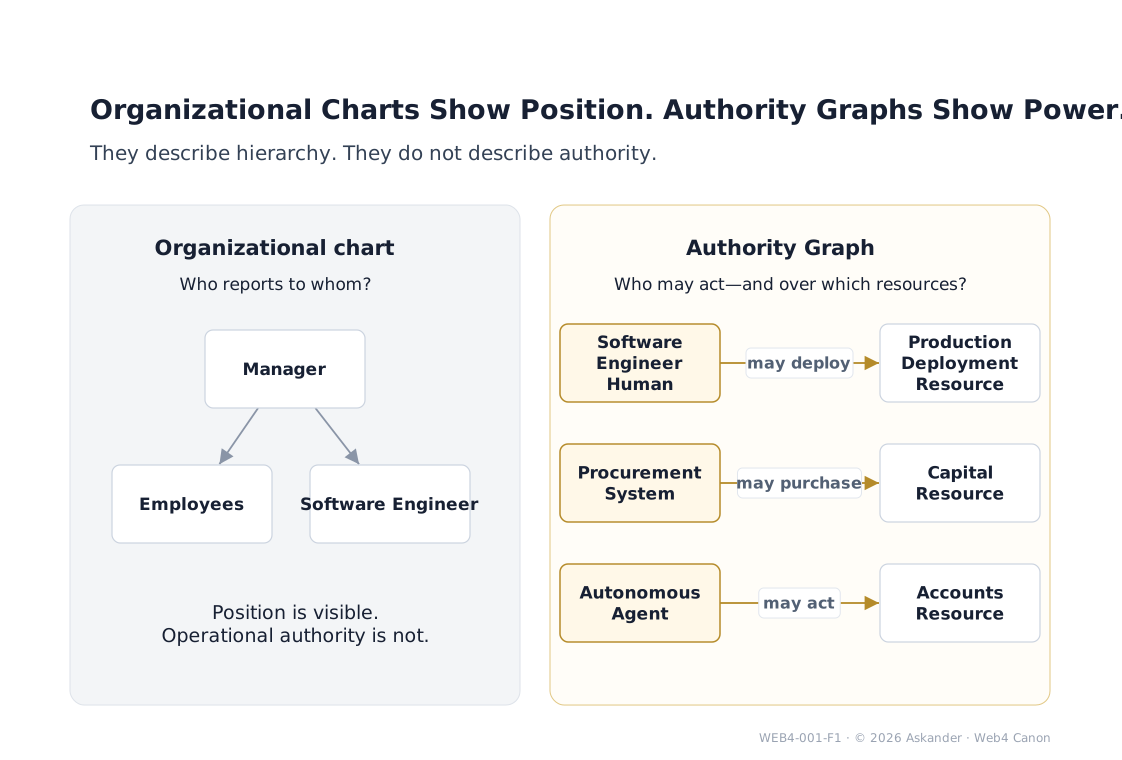
Now make the same problem larger: replace the children and ordinary objects with people, organizations, AI agents, robots, records, and resources moving at machine speed. An Authority Graph represents actors, resources, and explicit relationships of ownership, delegation, constraint, accountability, and revocation so authority can be followed and checked. Leaders gain a legible control plane for mixed human-and-agent organizations instead of relying on job titles, scattered access lists, or assumptions.
Pause at the moment the small system could go wrong. That is the design question the paper keeps in view: not whether people or helpers are clever, but whether the surrounding structure preserves the intended meaning when action scales.
That is why the small story holds: the authority graph is a permission-slip system for digital helpers.
Explain it to a CEO
Why leaders should care
Leaders gain a legible control plane for mixed human-and-agent organizations instead of relying on job titles, scattered access lists, or assumptions. An Authority Graph represents actors, resources, and explicit relationships of ownership, delegation, constraint, accountability, and revocation so authority can be followed and checked.
Explain it to an engineer
What the model means
Model principals, agents, organizations, systems, and resources as nodes; model scoped authority relationships as typed, queryable, revocable edges. The paper proposes infrastructure semantics, not a claim that graph storage alone enforces authorization.
Talk hook
Imagine waking up tomorrow with one million AI employees. Who is allowed to tell them what to do?
Ask the room
If a digital helper takes an important action, can your organization show the entire permission path?
Go deeper
The Canon is the source of truth.
WEB4-001 formalizes this structure: An Authority Graph represents actors, resources, and explicit relationships of ownership, delegation, constraint, accountability, and revocation so authority can be followed and checked. The ordinary-life story is an intuition aid, not a replacement definition; the canonical paper remains authoritative for scope, terminology, limitations, and argument.
Read WEB4-001 — the authoritative paper →