WEB4-012 · WEB4
The Web4 Stack
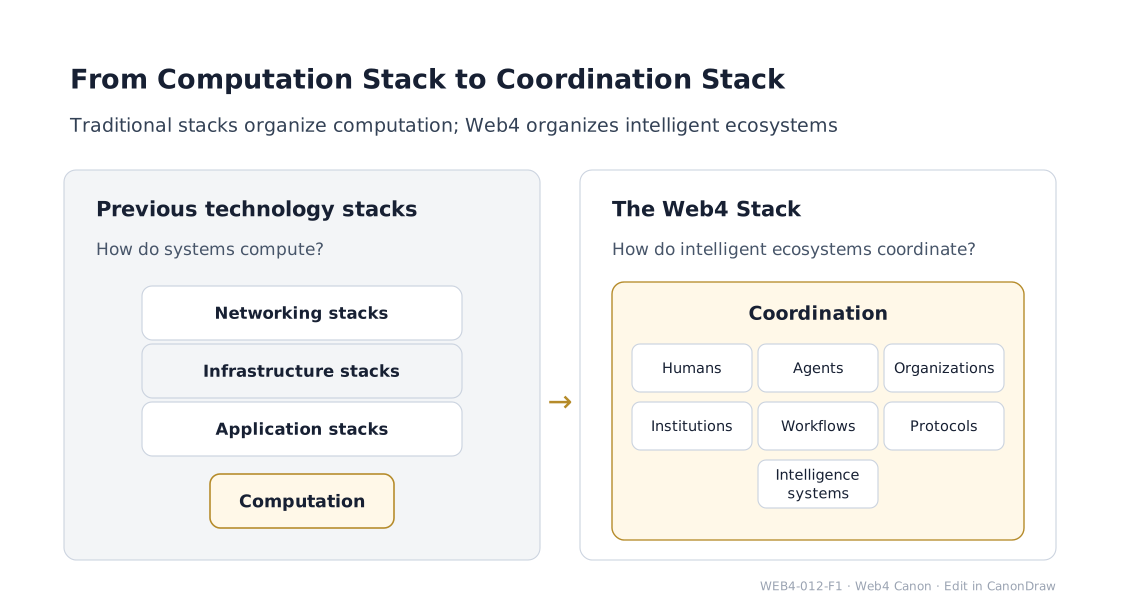
The Web4 Stack turns separate coordination pieces into one system.
01
Big idea
The Web4 Stack turns separate coordination pieces into one system.
Picture
See the structure
The simple version
Explain it like I’m ten
A city needs addresses so places can be found, roads so people can travel, records so facts can be checked, rules so power has limits, and helpers who can do work. Remove a layer and the city becomes harder to use safely.
Tell it at dinner
A story worth remembering
A city needs addresses so places can be found, roads so people can travel, records so facts can be checked, rules so power has limits, and helpers who can do work. Remove a layer and the city becomes harder to use safely.
Now make the same problem larger: replace the children and ordinary objects with people, organizations, AI agents, robots, records, and resources moving at machine speed. The Web4 Stack integrates identity, authority, delegation, registries, trust, governance, intelligence, agents, and human experience as a coordination architecture. A shared stack helps leaders see missing institutional layers and avoid treating a model or application as the whole autonomous system.
Pause at the moment the small system could go wrong. That is the design question the paper keeps in view: not whether people or helpers are clever, but whether the surrounding structure preserves the intended meaning when action scales.
That is why the small story holds: the web4 stack turns separate coordination pieces into one system.
Explain it to a CEO
Why leaders should care
A shared stack helps leaders see missing institutional layers and avoid treating a model or application as the whole autonomous system. The Web4 Stack integrates identity, authority, delegation, registries, trust, governance, intelligence, agents, and human experience as a coordination architecture.
Explain it to an engineer
What the model means
Architect the layers with explicit interfaces and separation of concerns: identity is not authority, trust is not permission, and intelligence is not governance. Implementations may vary while preserving those semantic boundaries.
Talk hook
A powerful model is one component; a governable institution is a stack.
Ask the room
Which layer is missing between your AI prototype and a trustworthy operating system?
Go deeper
The Canon is the source of truth.
WEB4-012 formalizes this structure: The Web4 Stack integrates identity, authority, delegation, registries, trust, governance, intelligence, agents, and human experience as a coordination architecture. The ordinary-life story is an intuition aid, not a replacement definition; the canonical paper remains authoritative for scope, terminology, limitations, and argument.
Read WEB4-012 — the authoritative paper →