INC-003 · INC
Incentive Alignment: The Foundation of Safe Delegation
Delegation is safer when the helper's reasons point toward the principal's goal.
01
Big idea
Delegation is safer when the helper's reasons point toward the principal's goal.
Picture
See the structure
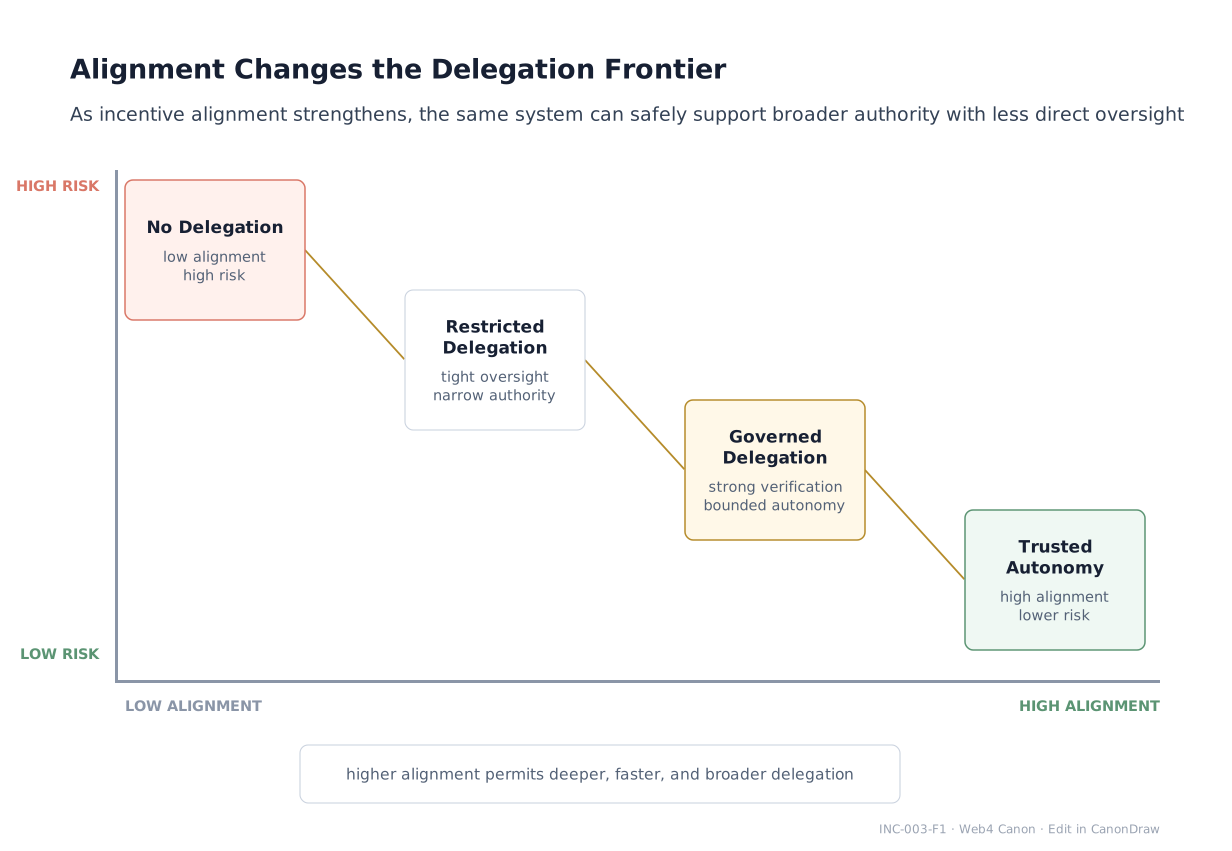
The simple version
Explain it like I’m ten
Four children row a boat. If each tries to reach a different shore, the boat spins. When they agree on the destination and help one another paddle, every stroke moves the group forward.
Tell it at dinner
A story worth remembering
Four children row a boat. If each tries to reach a different shore, the boat spins. When they agree on the destination and help one another paddle, every stroke moves the group forward.
Now make the same problem larger: replace the children and ordinary objects with people, organizations, AI agents, robots, records, and resources moving at machine speed. Incentive alignment makes desired behavior rational, legitimate, observable, and sustainable, reducing delegation risk across intelligent actors. Aligned incentives improve execution and trust without demanding constant supervision or assuming perfect obedience.
Pause at the moment the small system could go wrong. That is the design question the paper keeps in view: not whether people or helpers are clever, but whether the surrounding structure preserves the intended meaning when action scales.
That is why the small story holds: delegation is safer when the helper's reasons point toward the principal's goal.
Explain it to a CEO
Why leaders should care
Aligned incentives improve execution and trust without demanding constant supervision or assuming perfect obedience. Incentive alignment makes desired behavior rational, legitimate, observable, and sustainable, reducing delegation risk across intelligent actors.
Explain it to an engineer
What the model means
Map principal and agent objectives, perceived rewards, constraints, information asymmetry, time horizons, observability, and feedback. Alignment is contextual and dynamic, not a permanent scalar score.
Talk hook
Delegation fails when authority points one way and incentives pull another.
Ask the room
Where have you authorized one outcome while rewarding a different one?
Go deeper
The Canon is the source of truth.
INC-003 formalizes this structure: Incentive alignment makes desired behavior rational, legitimate, observable, and sustainable, reducing delegation risk across intelligent actors. The ordinary-life story is an intuition aid, not a replacement definition; the canonical paper remains authoritative for scope, terminology, limitations, and argument.
Read INC-003 — the authoritative paper →