WEB4-032 · WEB4
The Organizational Value Ontology
A shared vocabulary lets people and machines reason about value together.
01
Big idea
A shared vocabulary lets people and machines reason about value together.
Picture
See the structure
The simple version
Explain it like I’m ten
Children cleaning a workshop argue because one says “tools,” another says “supplies,” and another says “project things.” They agree on labels for the drawers, so everyone can put away and find the same things.
Tell it at dinner
A story worth remembering
Children cleaning a workshop argue because one says “tools,” another says “supplies,” and another says “project things.” They agree on labels for the drawers, so everyone can put away and find the same things.
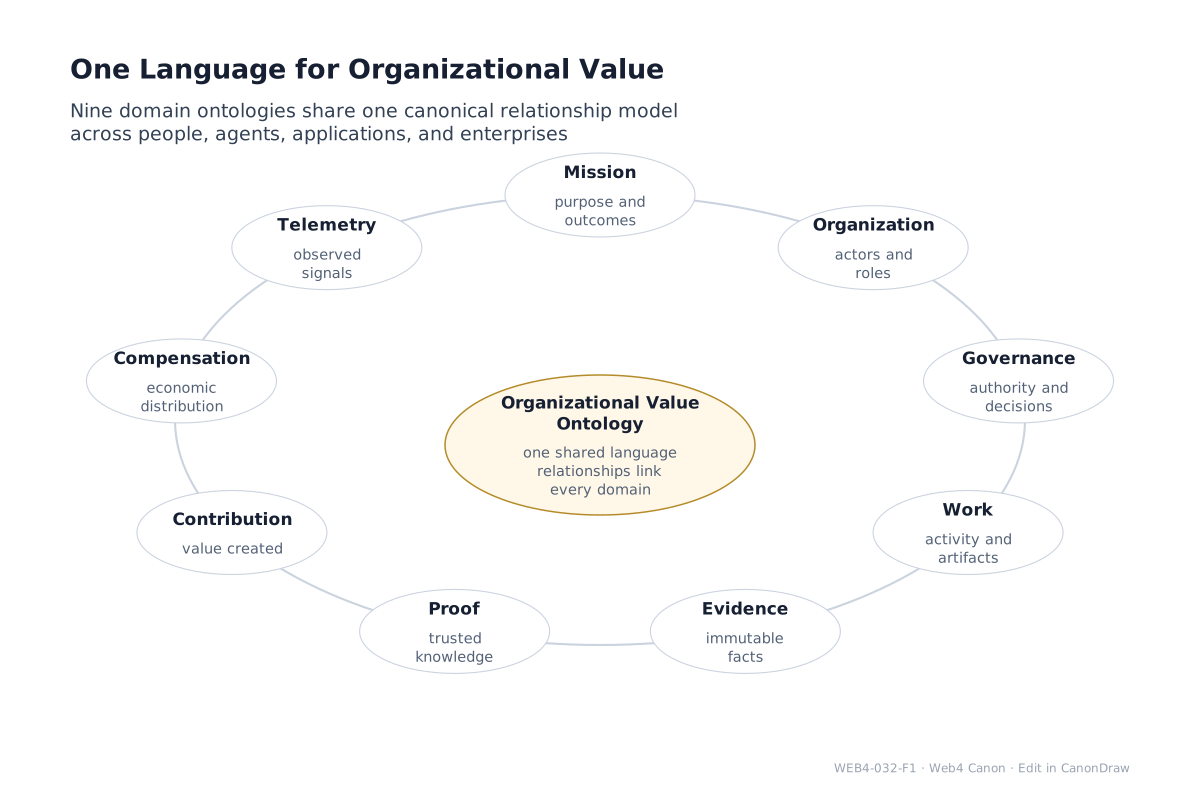
Now make the same problem larger: replace the children and ordinary objects with people, organizations, AI agents, robots, records, and resources moving at machine speed. The Organizational Value Ontology defines durable semantics for mission, contribution, proof, recognition, compensation, telemetry, learning, and value across products and implementations. A common ontology reduces integration ambiguity and gives analytics and AI a stable model across changing applications.
Pause at the moment the small system could go wrong. That is the design question the paper keeps in view: not whether people or helpers are clever, but whether the surrounding structure preserves the intended meaning when action scales.
That is why the small story holds: a shared vocabulary lets people and machines reason about value together.
Explain it to a CEO
Why leaders should care
A common ontology reduces integration ambiguity and gives analytics and AI a stable model across changing applications. The Organizational Value Ontology defines durable semantics for mission, contribution, proof, recognition, compensation, telemetry, learning, and value across products and implementations.
Explain it to an engineer
What the model means
Represent canonical entities, relations, constraints, identifiers, versioning, and mappings independent of UI or database choices. Ontological consistency should not erase legitimate contextual differences.
Talk hook
Interfaces change every few years; the meaning of the organization must last longer.
Ask the room
Which important business concept has five incompatible definitions across your systems?
Go deeper
The Canon is the source of truth.
WEB4-032 formalizes this structure: The Organizational Value Ontology defines durable semantics for mission, contribution, proof, recognition, compensation, telemetry, learning, and value across products and implementations. The ordinary-life story is an intuition aid, not a replacement definition; the canonical paper remains authoritative for scope, terminology, limitations, and argument.
Read WEB4-032 — the authoritative paper →