WEB4-031 · WEB4
The Organizational Value Translation Layer
A translation layer lets different systems describe one organization coherently.
01
Big idea
A translation layer lets different systems describe one organization coherently.
Picture
See the structure
The simple version
Explain it like I’m ten
Three clubs describe the same school event differently: one has goals, one has chores, and one has scorecards. A shared legend shows how their words fit together without throwing away the original lists.
Tell it at dinner
A story worth remembering
Three clubs describe the same school event differently: one has goals, one has chores, and one has scorecards. A shared legend shows how their words fit together without throwing away the original lists.
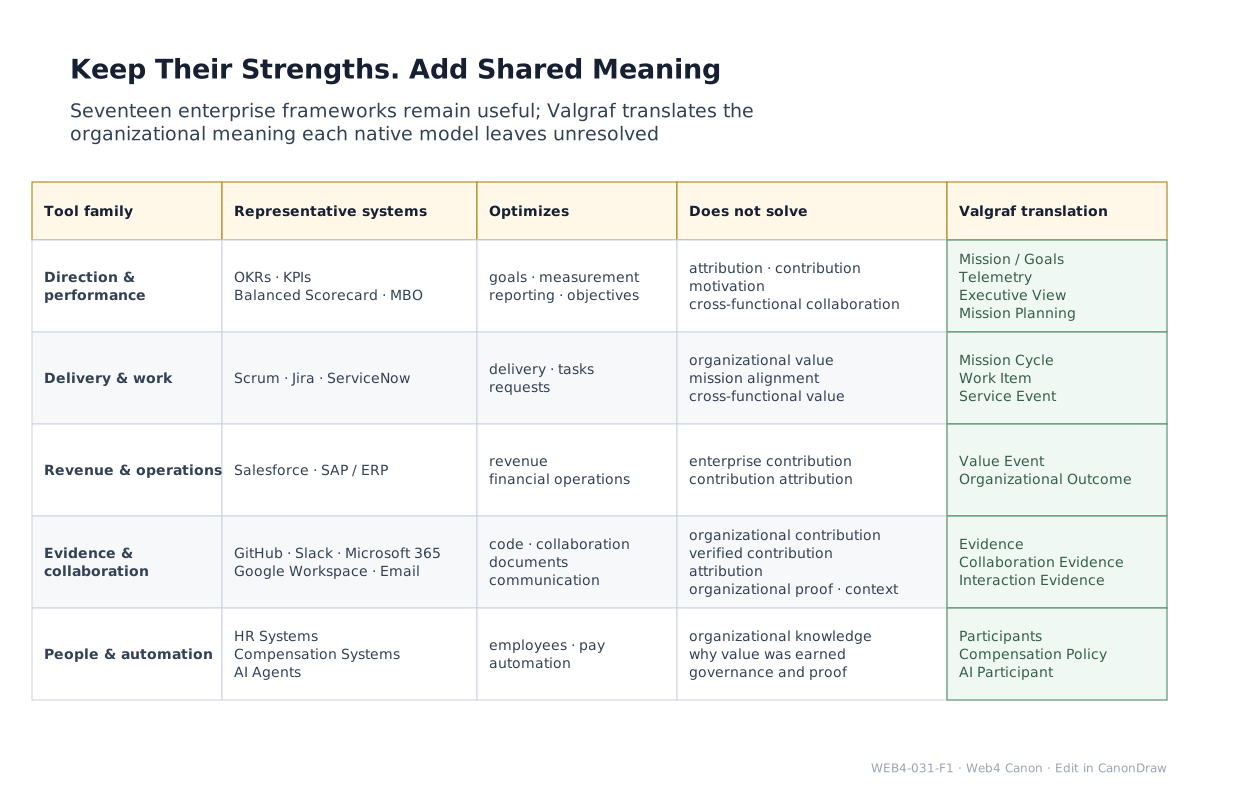
Now make the same problem larger: replace the children and ordinary objects with people, organizations, AI agents, robots, records, and resources moving at machine speed. The Organizational Value Translation Layer maps existing enterprise frameworks, tools, workflows, and AI systems into a shared value ontology without replacing them. Leaders can connect fragmented planning, work, measurement, risk, finance, and people systems while preserving prior investments.
Pause at the moment the small system could go wrong. That is the design question the paper keeps in view: not whether people or helpers are clever, but whether the surrounding structure preserves the intended meaning when action scales.
That is why the small story holds: a translation layer lets different systems describe one organization coherently.
Explain it to a CEO
Why leaders should care
Leaders can connect fragmented planning, work, measurement, risk, finance, and people systems while preserving prior investments. The Organizational Value Translation Layer maps existing enterprise frameworks, tools, workflows, and AI systems into a shared value ontology without replacing them.
Explain it to an engineer
What the model means
Implement semantic mappings, adapters, provenance, confidence, and conflict handling between source models and the shared ontology. Translation must preserve source meaning rather than forcing false equivalence.
Talk hook
Most enterprises do not lack systems; they lack a common language between them.
Ask the room
Which two systems describe the same work today but cannot reconcile their meanings?
Go deeper
The Canon is the source of truth.
WEB4-031 formalizes this structure: The Organizational Value Translation Layer maps existing enterprise frameworks, tools, workflows, and AI systems into a shared value ontology without replacing them. The ordinary-life story is an intuition aid, not a replacement definition; the canonical paper remains authoritative for scope, terminology, limitations, and argument.
Read WEB4-031 — the authoritative paper →