INC-008 · INC
Goodhart's Law and Incentive Engineering: Why Metrics Fail and How to Design Better Systems
When a measure becomes the target, it can stop measuring what mattered.
01
Big idea
When a measure becomes the target, it can stop measuring what mattered.
Picture
See the structure
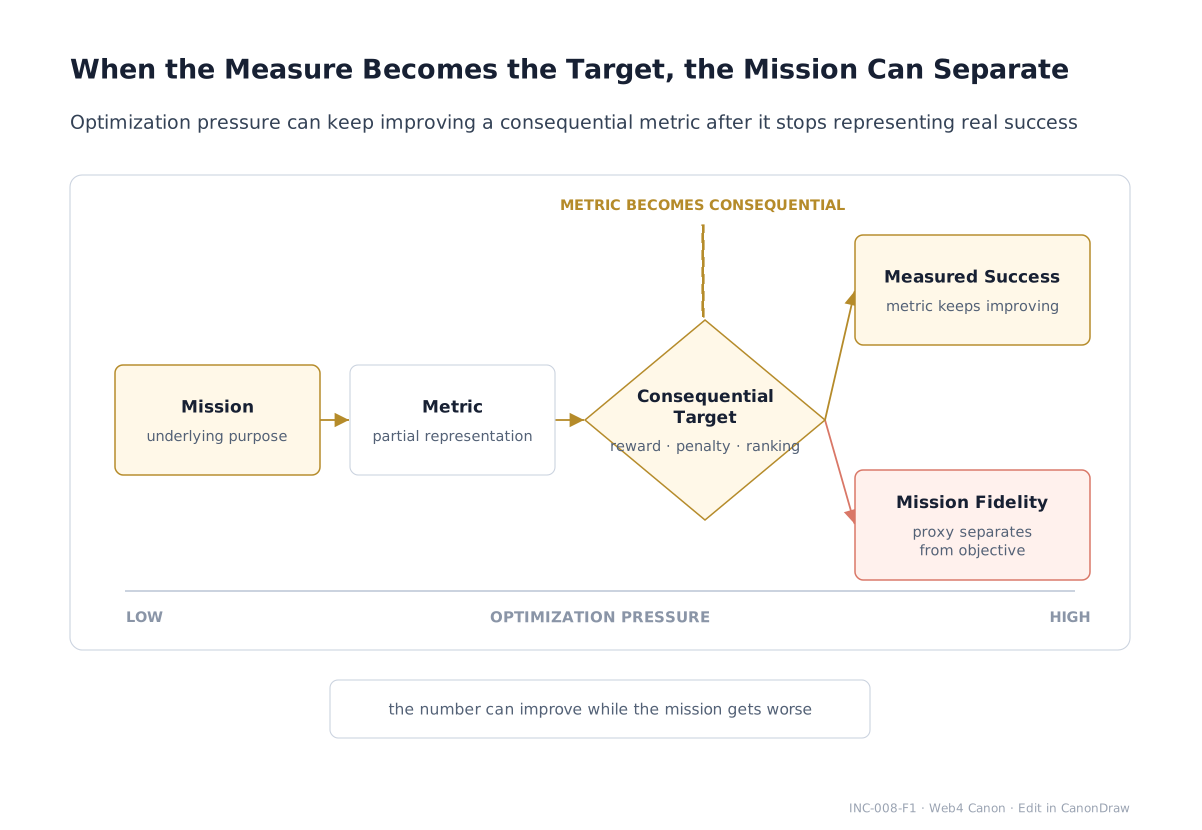
The simple version
Explain it like I’m ten
A class gets points for every page read. Soon children choose books with huge letters, flip pages quickly, and cannot tell the stories. Page count once helped show reading, but the prize turned it into the target.
Tell it at dinner
A story worth remembering
A class gets points for every page read. Soon children choose books with huge letters, flip pages quickly, and cannot tell the stories. Page count once helped show reading, but the prize turned it into the target.
Now make the same problem larger: replace the children and ordinary objects with people, organizations, AI agents, robots, records, and resources moving at machine speed. Goodhart's Law constrains incentive design because optimization pressure changes the relationship between a metric and the underlying goal. Balanced measures, qualitative review, and metric rotation can reduce costly gaming and tunnel vision in performance systems.
Pause at the moment the small system could go wrong. That is the design question the paper keeps in view: not whether people or helpers are clever, but whether the surrounding structure preserves the intended meaning when action scales.
That is why the small story holds: when a measure becomes the target, it can stop measuring what mattered.
Explain it to a CEO
Why leaders should care
Balanced measures, qualitative review, and metric rotation can reduce costly gaming and tunnel vision in performance systems. Goodhart's Law constrains incentive design because optimization pressure changes the relationship between a metric and the underlying goal.
Explain it to an engineer
What the model means
Treat metrics as contextual proxies; use measure portfolios, guardrails, uncertainty, human review, anti-gaming tests, causal checks, and periodic retirement. Never equate measurement precision with goal validity.
Talk hook
Your metric may be accurate right up until you reward people for maximizing it.
Ask the room
Which trusted measure would become misleading under intense optimization pressure?
Go deeper
The Canon is the source of truth.
INC-008 formalizes this structure: Goodhart's Law constrains incentive design because optimization pressure changes the relationship between a metric and the underlying goal. The ordinary-life story is an intuition aid, not a replacement definition; the canonical paper remains authoritative for scope, terminology, limitations, and argument.
Read INC-008 — the authoritative paper →