WEB4-038 · WEB4
Incentivis
Rewards should reinforce the mission, not merely the easiest thing to count.
01
Big idea
Rewards should reinforce the mission, not merely the easiest thing to count.
Picture
See the structure
The simple version
Explain it like I’m ten
A teacher gives stickers only for finishing fastest. Soon children rush and stop helping one another. She changes the board to recognize careful work, kindness, improvement, and teamwork, then watches whether the class gets better.
Tell it at dinner
A story worth remembering
A teacher gives stickers only for finishing fastest. Soon children rush and stop helping one another. She changes the board to recognize careful work, kindness, improvement, and teamwork, then watches whether the class gets better.
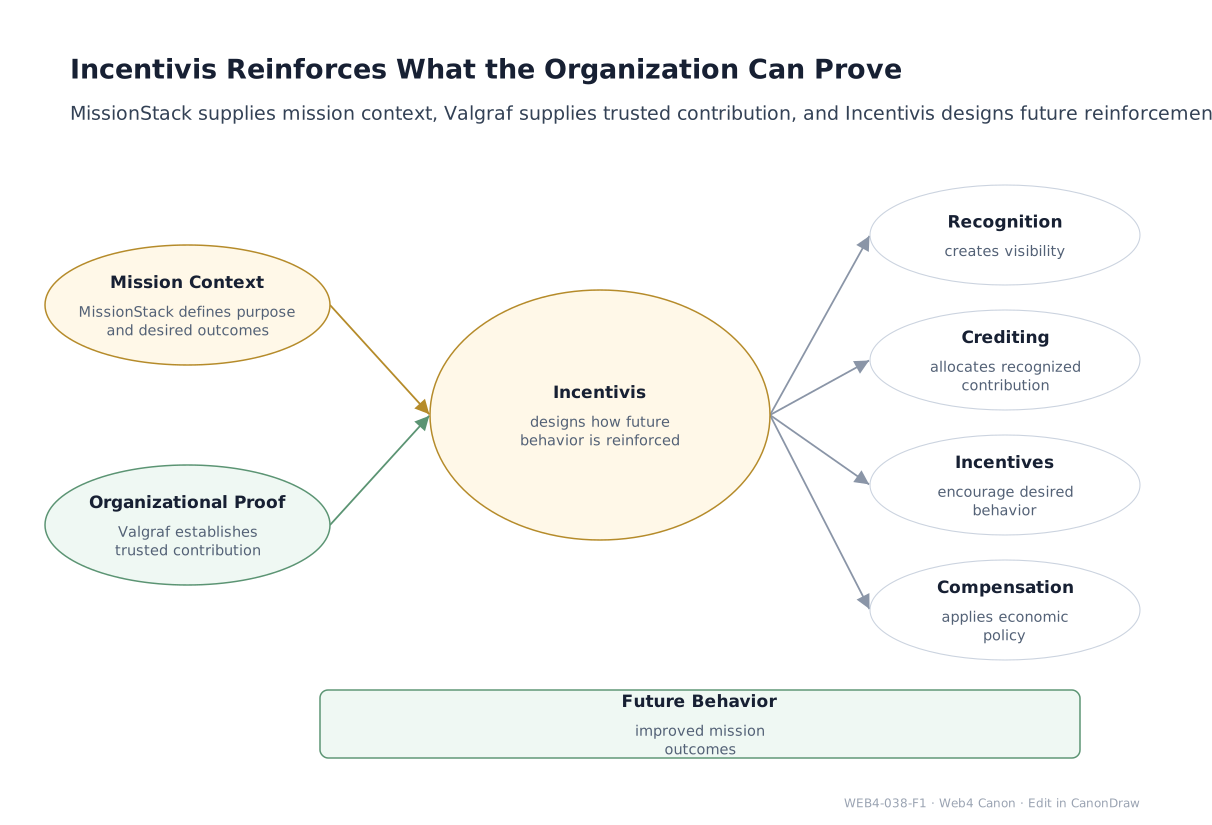
Now make the same problem larger: replace the children and ordinary objects with people, organizations, AI agents, robots, records, and resources moving at machine speed. Incentivis uses trusted contribution intelligence to design recognition, crediting, incentives, and compensation aligned with mission outcomes. Evidence-based incentive design can improve behavior and fairness while reducing gaming and disconnected reward programs.
Pause at the moment the small system could go wrong. That is the design question the paper keeps in view: not whether people or helpers are clever, but whether the surrounding structure preserves the intended meaning when action scales.
That is why the small story holds: rewards should reinforce the mission, not merely the easiest thing to count.
Explain it to a CEO
Why leaders should care
Evidence-based incentive design can improve behavior and fairness while reducing gaming and disconnected reward programs. Incentivis uses trusted contribution intelligence to design recognition, crediting, incentives, and compensation aligned with mission outcomes.
Explain it to an engineer
What the model means
Consume proof and contribution data from upstream systems; model desired behavior, incentive mechanisms, eligibility, timing, caps, Goodhart risks, feedback, and adaptation. Incentivis should not manufacture contribution evidence.
Talk hook
Every organization has incentives—the question is whether they point toward the mission.
Ask the room
What behavior does your current recognition system encourage unintentionally?
Go deeper
The Canon is the source of truth.
WEB4-038 formalizes this structure: Incentivis uses trusted contribution intelligence to design recognition, crediting, incentives, and compensation aligned with mission outcomes. The ordinary-life story is an intuition aid, not a replacement definition; the canonical paper remains authoritative for scope, terminology, limitations, and argument.
Read WEB4-038 — the authoritative paper →