WEB4-036 · WEB4
Organizational Accounting
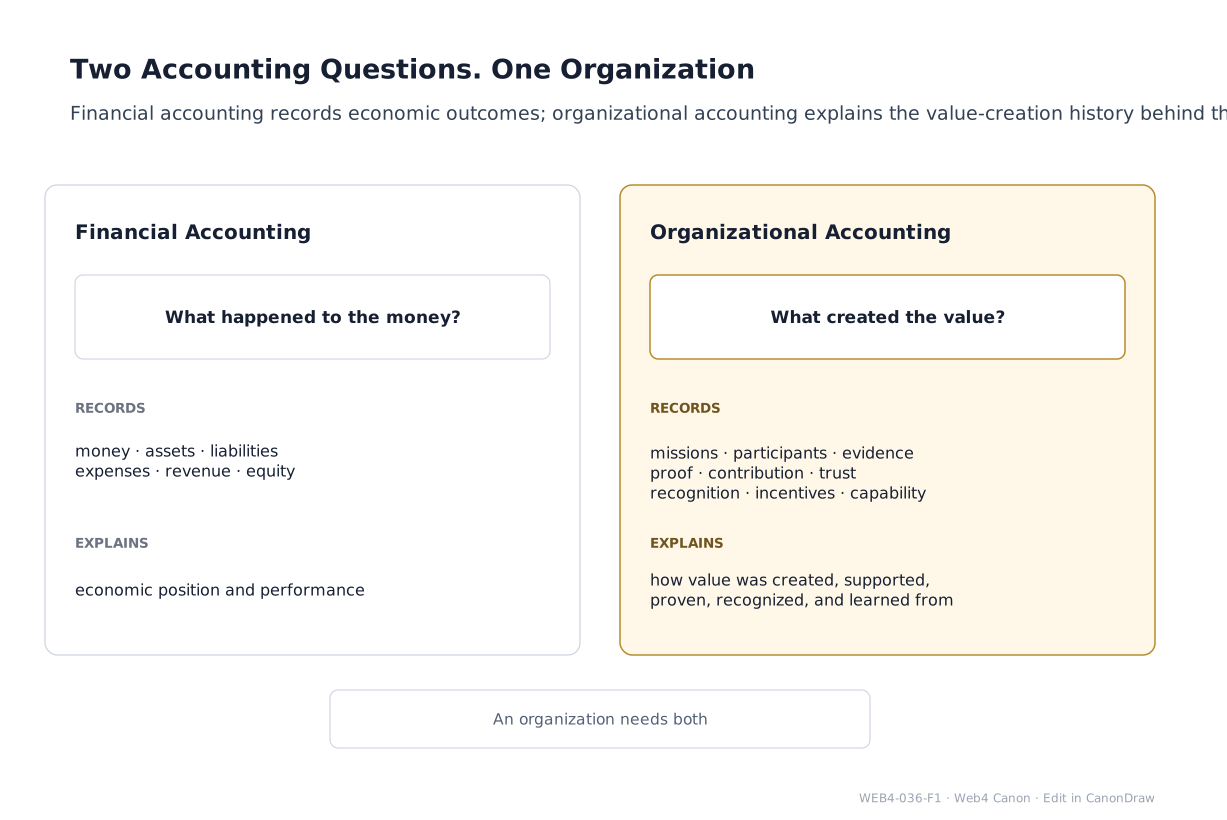
Financial accounting follows money; organizational accounting follows what created value.
01
Big idea
Financial accounting follows money; organizational accounting follows what created value.
Picture
See the structure
The simple version
Explain it like I’m ten
A lemonade stand counts coins, but the coin jar does not show who found the recipe, fixed the sign, brought cups, or made customers return. A second notebook records how the stand created value.
Tell it at dinner
A story worth remembering
A lemonade stand counts coins, but the coin jar does not show who found the recipe, fixed the sign, brought cups, or made customers return. A second notebook records how the stand created value.
Now make the same problem larger: replace the children and ordinary objects with people, organizations, AI agents, robots, records, and resources moving at machine speed. Organizational Accounting records, verifies, attributes, and stewards organizational value creation alongside—not in place of—financial accounting. Leaders gain a disciplined view of contribution, capability, and value flows that supports better investment, recognition, and learning.
Pause at the moment the small system could go wrong. That is the design question the paper keeps in view: not whether people or helpers are clever, but whether the surrounding structure preserves the intended meaning when action scales.
That is why the small story holds: financial accounting follows money; organizational accounting follows what created value.
Explain it to a CEO
Why leaders should care
Leaders gain a disciplined view of contribution, capability, and value flows that supports better investment, recognition, and learning. Organizational Accounting records, verifies, attributes, and stewards organizational value creation alongside—not in place of—financial accounting.
Explain it to an engineer
What the model means
Define accounts or records for missions, activities, evidence, provenance, contribution, outcomes, and stewardship with controls, periods, reconciliation, and auditability. Avoid false monetary precision where value is qualitative or contested.
Talk hook
We can trace every dollar. Can we trace what actually created the value?
Ask the room
Which high-value contribution is invisible in your financial and operational ledgers?
Go deeper
The Canon is the source of truth.
WEB4-036 formalizes this structure: Organizational Accounting records, verifies, attributes, and stewards organizational value creation alongside—not in place of—financial accounting. The ordinary-life story is an intuition aid, not a replacement definition; the canonical paper remains authoritative for scope, terminology, limitations, and argument.
Read WEB4-036 — the authoritative paper →