WEB4-027 · WEB4
The Constitutional Agent
A constitutional agent carries the rules of legitimate action into operation.
01
Big idea
A constitutional agent carries the rules of legitimate action into operation.
Picture
See the structure
The simple version
Explain it like I’m ten
A family’s helper robot carries a card: stay out of the street, never open the medicine box, ask an adult before inviting anyone in, and stop when told. The rules travel with the helper and tell it when to ask for help.
Tell it at dinner
A story worth remembering
A family’s helper robot carries a card: stay out of the street, never open the medicine box, ask an adult before inviting anyone in, and stop when told. The rules travel with the helper and tell it when to ask for help.
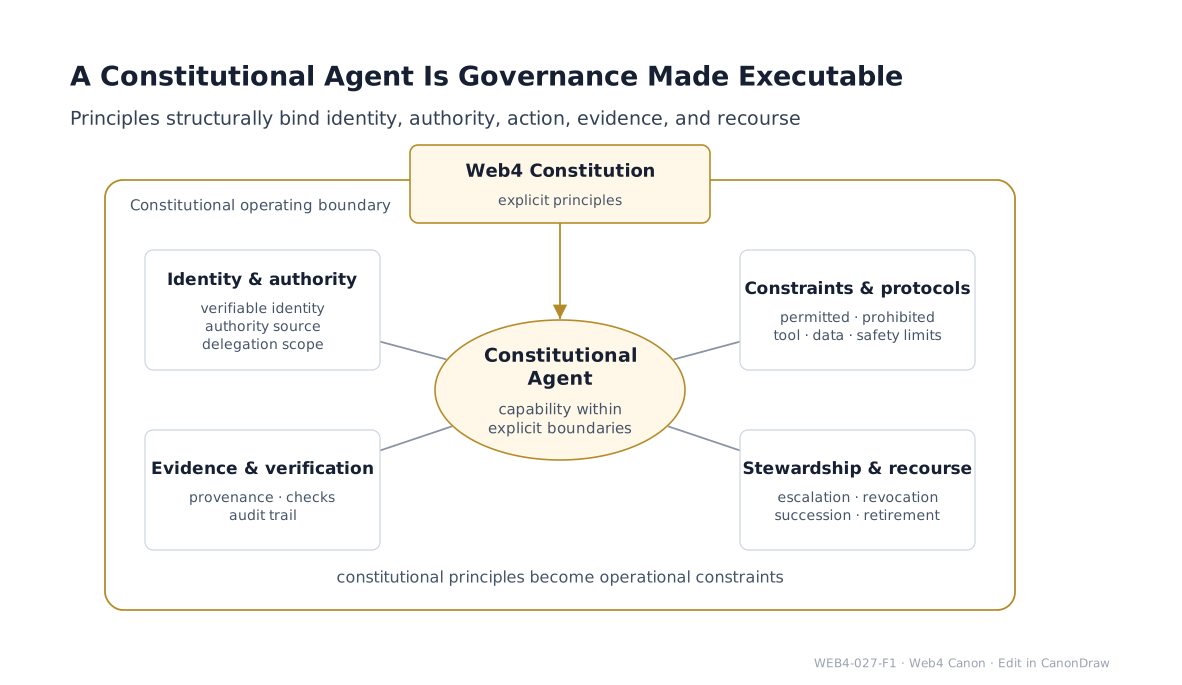
Now make the same problem larger: replace the children and ordinary objects with people, organizations, AI agents, robots, records, and resources moving at machine speed. The Constitutional Agent operationalizes constitutional principles through explicit constraints, authority boundaries, escalation, stewardship, auditability, verification, and revocation. Constitutional agents make high-level governance testable in runtime systems instead of leaving it in policy documents.
Pause at the moment the small system could go wrong. That is the design question the paper keeps in view: not whether people or helpers are clever, but whether the surrounding structure preserves the intended meaning when action scales.
That is why the small story holds: a constitutional agent carries the rules of legitimate action into operation.
Explain it to a CEO
Why leaders should care
Constitutional agents make high-level governance testable in runtime systems instead of leaving it in policy documents. The Constitutional Agent operationalizes constitutional principles through explicit constraints, authority boundaries, escalation, stewardship, auditability, verification, and revocation.
Explain it to an engineer
What the model means
Project constitutional requirements into machine-readable constraints, delegation envelopes, policy evaluation, evidence, escalation paths, review, and revocation. No prompt alone should be assumed to provide constitutional enforcement.
Talk hook
A constitution matters only when it can constrain the actor at the moment of choice.
Ask the room
Which principle in your AI policy is not represented anywhere in runtime controls?
Go deeper
The Canon is the source of truth.
WEB4-027 formalizes this structure: The Constitutional Agent operationalizes constitutional principles through explicit constraints, authority boundaries, escalation, stewardship, auditability, verification, and revocation. The ordinary-life story is an intuition aid, not a replacement definition; the canonical paper remains authoritative for scope, terminology, limitations, and argument.
Read WEB4-027 — the authoritative paper →