WEB4-014 · WEB4
Native Value Systems
Not everything valuable is money, and not every kind of value should be traded.
01
Big idea
Not everything valuable is money, and not every kind of value should be traded.
Picture
See the structure
The simple version
Explain it like I’m ten
At camp, money cannot tell the whole story. One badge shows who learned first aid, another who cared for the garden, and another who may lead a canoe trip. The badges mean different things, and some must be earned instead of bought.
Tell it at dinner
A story worth remembering
At camp, money cannot tell the whole story. One badge shows who learned first aid, another who cared for the garden, and another who may lead a canoe trip. The badges mean different things, and some must be earned instead of bought.
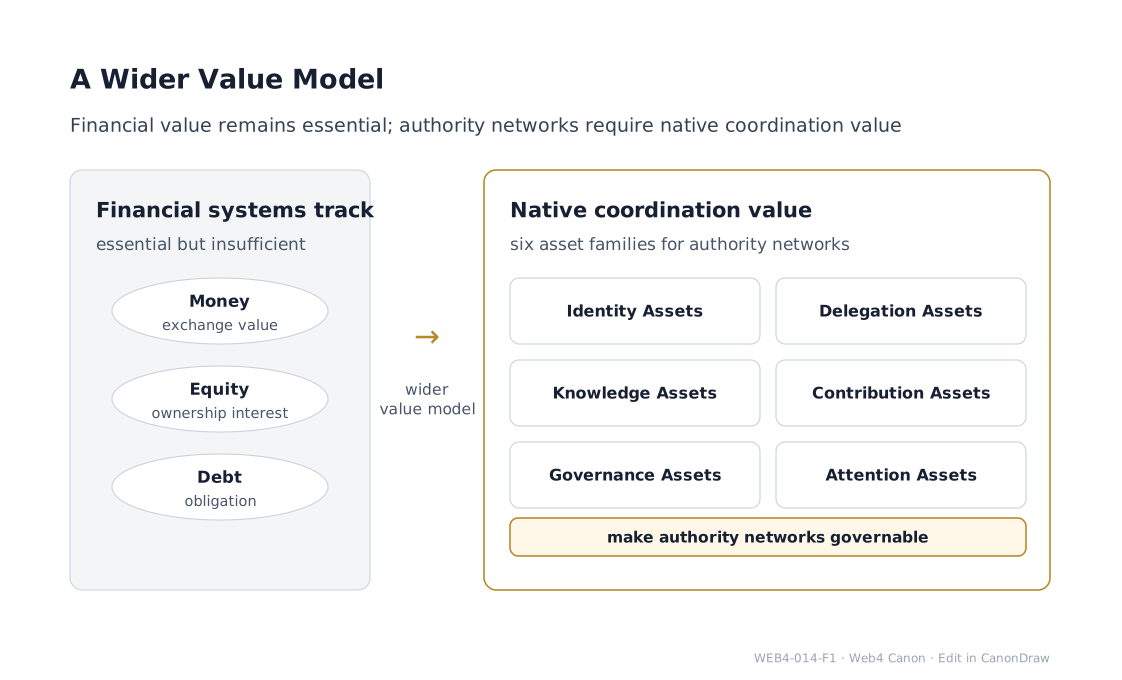
Now make the same problem larger: replace the children and ordinary objects with people, organizations, AI agents, robots, records, and resources moving at machine speed. Web4 needs native representations for authority, trust, reputation, verification, stewardship, contribution, knowledge, and other institutional value beyond currency. Organizations can recognize and govern forms of value that financial systems overlook without forcing every signal into a price.
Pause at the moment the small system could go wrong. That is the design question the paper keeps in view: not whether people or helpers are clever, but whether the surrounding structure preserves the intended meaning when action scales.
That is why the small story holds: not everything valuable is money, and not every kind of value should be traded.
Explain it to a CEO
Why leaders should care
Organizations can recognize and govern forms of value that financial systems overlook without forcing every signal into a price. Web4 needs native representations for authority, trust, reputation, verification, stewardship, contribution, knowledge, and other institutional value beyond currency.
Explain it to an engineer
What the model means
Define distinct asset types, rights, issuance rules, transferability, verification, lifecycle, provenance, and governance. Avoid collapsing heterogeneous institutional signals into one fungible token.
Talk hook
What does your organization value deeply but fail to represent anywhere?
Ask the room
Which important form of value would be damaged if it could simply be bought?
Go deeper
The Canon is the source of truth.
WEB4-014 formalizes this structure: Web4 needs native representations for authority, trust, reputation, verification, stewardship, contribution, knowledge, and other institutional value beyond currency. The ordinary-life story is an intuition aid, not a replacement definition; the canonical paper remains authoritative for scope, terminology, limitations, and argument.
Read WEB4-014 — the authoritative paper →