SPACE-001 · SPACE
Mission Authority Systems
Distance makes explicit mission authority more important, not less.
01
Big idea
Distance makes explicit mission authority more important, not less.
Picture
See the structure
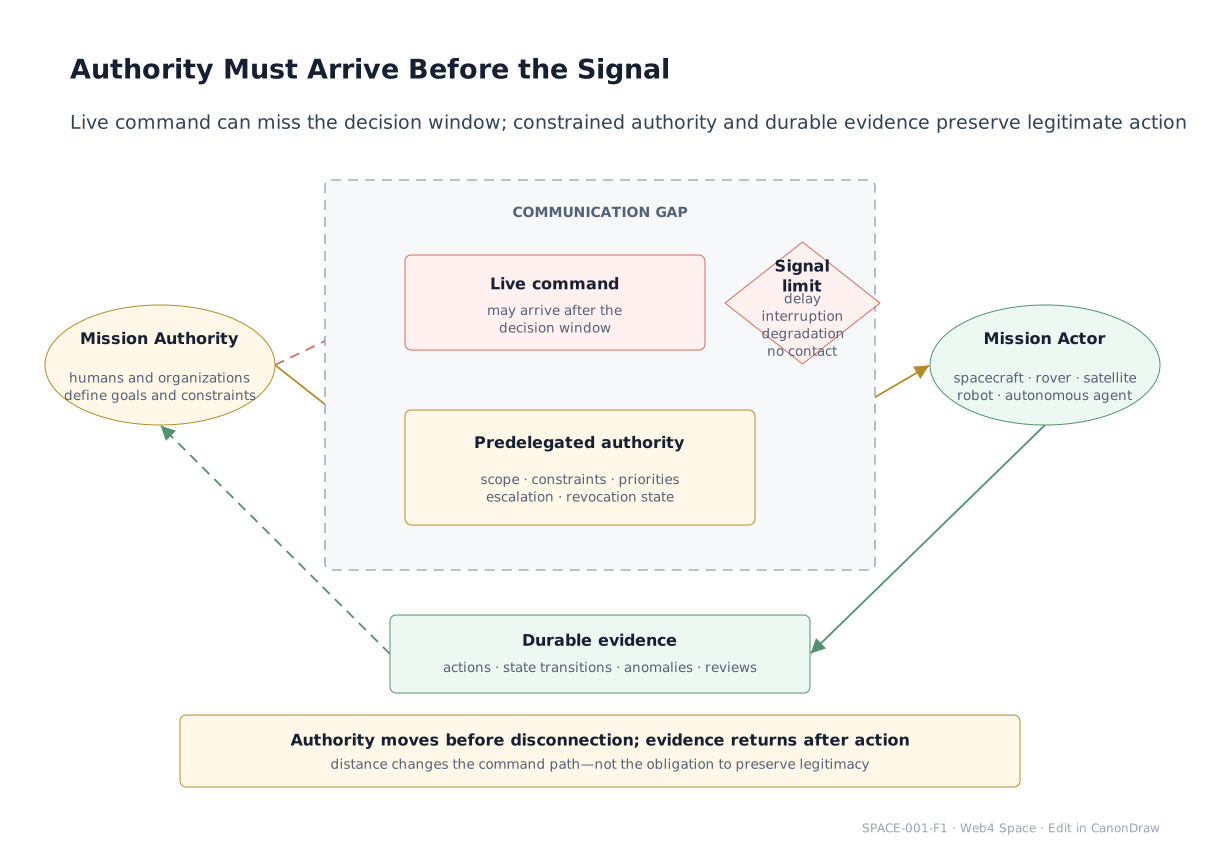
The simple version
Explain it like I’m ten
A rover is very far from home. It cannot ask a person about every rock. It carries a mission card saying where it may go, how much power it may use, when it must stop, what it must remember, and when it must wait for Earth.
Tell it at dinner
A story worth remembering
A rover is very far from home. It cannot ask a person about every rock. It carries a mission card saying where it may go, how much power it may use, when it must stop, what it must remember, and when it must wait for Earth.
Now make the same problem larger: replace the children and ordinary objects with people, organizations, AI agents, robots, records, and resources moving at machine speed. Mission Authority Systems apply identity, delegation, wallets, trust, stewardship, memory, lifecycle, and bounded autonomy to long-duration, delayed, multi-actor space operations. Space missions gain a governance architecture that can survive latency, intermittent communication, changing crews, long lifecycles, and autonomous physical action.
Pause at the moment the small system could go wrong. That is the design question the paper keeps in view: not whether people or helpers are clever, but whether the surrounding structure preserves the intended meaning when action scales.
That is why the small story holds: distance makes explicit mission authority more important, not less.
Explain it to a CEO
Why leaders should care
Space missions gain a governance architecture that can survive latency, intermittent communication, changing crews, long lifecycles, and autonomous physical action. Mission Authority Systems apply identity, delegation, wallets, trust, stewardship, memory, lifecycle, and bounded autonomy to long-duration, delayed, multi-actor space operations.
Explain it to an engineer
What the model means
Model mission authority, identities, spacecraft and robot capabilities, delegation envelopes, delay-tolerant state, budgets, time, communications, local decisions, checkpoints, evidence, provenance, revocation limits, continuity, and stewardship. The paper composes existing canon rather than replacing it.
Talk hook
What does authorization mean when the nearest human answer is minutes—or months—away?
Ask the room
Which decisions must a distant mission system make locally, and which must remain impossible without Earth?
Go deeper
The Canon is the source of truth.
SPACE-001 formalizes this structure: Mission Authority Systems apply identity, delegation, wallets, trust, stewardship, memory, lifecycle, and bounded autonomy to long-duration, delayed, multi-actor space operations. The ordinary-life story is an intuition aid, not a replacement definition; the canonical paper remains authoritative for scope, terminology, limitations, and argument.
Read SPACE-001 — the authoritative paper →